Kykotsmovi, AZ – On Dec. 1, the Hopi Tribe inaugurated the “People’s Chairman,” Timothy L. Nuvangyaoma, of Mishongnovi Village.
Nuvangyaoma has a degree in management and previously worked in the finance industry. Most importantly, he ran on a platform in which he acknowledges that there are many knowledgeable people in the Hopi community that need to be involved in the solutions for the issues that are brought forward. He has stated that he wants the Hopi community to be part of these solutions. Hopi language and culture are very important to him, leading him to volunteer for KUYI, the Hopi reservation-based radio station, which strives to reaffirm respect for tradition by “preserving language and culture in a contemporary context” with a particular emphasis on Hopi perspectives and interests.
Nuvangyaoma’s Senior Staff will include Bruce Talawyma, Malinda Andrews, and Nikishna Polequaptewa. Bruce Talawyma, a Marine Corps Veteran, retired as Chief Administrative Officer for Indian Health Service at the Hopi Health Care Center after 43 years of service. Talawyma served in Vietnam’s 1st Marine Division, 7th Communications Battalion. He began his career at Hopi Day School in Kykotsmovi, Arizona, attended Phoenix Indian School, and graduated from Central High School. He earned an Associate Degree in Business from the Haskell Institute and secured his first job in the Housing and Urban Development Administration in Los Angeles, California. He also worked for the Department of Labor as a Human Resource Specialist for the BIA.
Polequaptewa strives to help Native American students
IRVINE, Calif. – Nikishna Polequaptewa has recently received two new honors to add to a growing list. At only 27, that list is impressive, but it hasn’t gone to his head. He continues to work towards his life-long goal of helping other Native American students rise up to reach their own dreams.
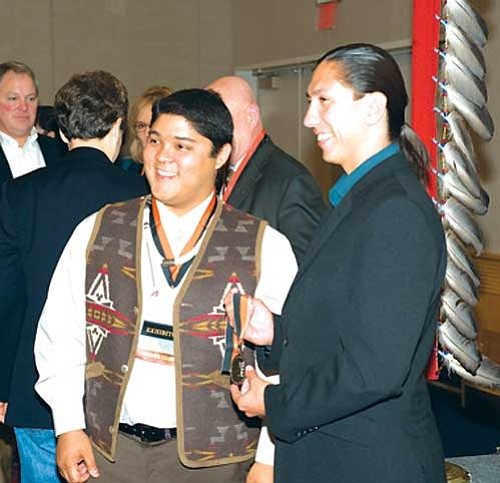
Most recently, Polequaptewa was gifted with an American Indian Science and Engineering Society (AISES) Sequoyah Fellowship, and participated in the blessing ceremony at the National Conference in Portland, Ore. Polequaptewa was also named as one of 40 young existing and emerging Native American leaders to receive the National Center for American Indian Development’s (NCAID) “Native American 40 Under 40” awards.
Nikishna receives AISES Sequoyah Fellowship Medal
An AISES Sequoyah Fellow is a lifetime member of AISES,” said April Armijo, AISES Information Services Coordinator. “Many individuals purchase a Sequoyah Fellowship for themselves and then go onto gifting one to another.”
Nikishna’s was sponsored by Todd Ambo, an engineer at 3M from the Juaneno Band of Mission Indians, Acjachemen Nation, who was also gifted last year in Anaheim. An AISES Sequoyah Fellow is regarded as a representative members of AISES who supports the organization to overcome obstacles and achieve immeasurable growth and success.
Armijo shared Ambo’s reasoning.
“He’s a great role model and has overcome many trials and tribulations,” Ambo said. “[Nikishna] is a young and very inspiring person and I believe that he will accomplish many great things for native people in the future.”
Indeed, Polequaptewa has faced adversity. His mother abandoned him as a baby, and was forced into a series of foster homes when his father went to prison. But this hasn’t stopped this industrious young Hopi from creating his own future.
“I was really surprised to learn that I’d been sponsored for the Sequoyah Fellowship,” Polequaptewa said. “And as for the 40
Under 40 award – I was the only individual in Education to win this award. It was pretty neat to receive it – NCAID is the oldest nationwide organization of its kind, and this is the first time they’ve offered [it.]”
A string of achievements prove this 27-year-old member of the Badger and Spider Clans is moving forward at a rapid pace. He credits a strong identification with his Hopi people as well as his desire to help other young people for driving him forward.
Polequaptewa currently serves as the Director of the American Indian Resource Program (AIRP) of the University of California, Irvine, where he is able to live his dream of helping Native American students attain higher education.
“Our main project is an American Indian Summer Institute in Computer Sciences, which is an intensive summer residential program, primarily funded by the National Science Foundation,” he said.
“We take eighth grade students going into ninth grade and 11th grade students going into 12th grade from all over the country. We pay for everything – transportation, housing, food, books, and entertainment.”
Young people interested in attending the program should go to www.airp.uci.edu; applications should be submitted in January.
“This project is unique in that we don’t base attendance on a student’s grade point average,” Polequaptewa said. “We base our selection totally on their essay on why … they want to come to our camp.”
Further, students who don’t have a census number are not rejected; rather, they are accepted on a self-identification basis.
“Ninety-five percent of our students go on to attend great universities-even if their grade point average was only 1.9 when they came to us,” Polequaptewa said. “We serve students from kindergarten through PhD candidates. We help students be eligible for the right tests and to get into the college of their choice. Once there, we work on retention.”
Polequaptewa and his colleagues are there to support students through the challenges and frustrations that face young American Indian students-including overcoming boarding school experiences that often offer little in the way of preparing students to be self-sufficient young adults who will attend college off-reservation.
“We didn’t start this program without the help of others,” Polequaptewa said. “A key organization is the Center for Educational Partnerships, which provides us with free office space and supplies.
Polequaptewa intends to spend the second half of his life at Hopi.
“Ever since I was little, I wanted to serve as the Hopi Tribal Chairman,” Polequaptewa continued. “I want to serve in the best capacity possible, with valuable resources to bring to the Tribe.”
Polequaptewa said that his plan is to serve his people-and by becoming financially stable should he achieve his goal of Chairman.
KYKOTSMOVI, Ariz. – On May 13, the Hopi Tribal Council passed a resolution to start the Hopi Tutuveni newspaper after it was suspended in 2009 “in an attempt [to] improperly restrict and withhold information from the Hopi people” according to the resolution.
Seven months later, no newspaper has been printed after the Chairman was “directed to carry out this resolution in such a way that begins the proper publication of the Tutuveni.”
In archaic times the term Tutuveni was used to describe petroglyphs on cliffs and rocks throughout the southwest. This was the ancient way of communication during the migrations and ceremonial purposes of the Hopi people.
Petroglyphs marked the clans that had gone through the area or explained what may have occurred in a particular village or area for others to know what happened. This also was a way to put into writing the ancient claim to the land by Hopi people and their ancestors. Desecration of these rock writings is akin to erasing the history of the ancient people of the southwest.
The Tutuveni newspaper was therefore a cherished publication of the Hopi people, but due to the political turmoil in 2009, the paper ceased operation due to some harsh criticism by the Hopi Tribal government. Many articles were written in Hopi, which was a unique way to communicate to the Hopi people. One item of interest was the Hopi search word puzzle that had Hopi words to look for in the puzzle.
Hopi people looked forward to the newspaper every Thursday to read about the Hopi community. It provided information to people outside the reservation as well since there was no online format.
Nikishna Polequaptewa from the University of California at Irvine says he has created a template for an online version of the Tutuveni that he presented to the Chairman for consideration. He explained with this template, an online version of the newspaper could be established with ease, much like other publications.
In the past, Chairman Shingoitewa commented that he wanted to see the paper started in September. However, there has been no change in its current status. He also remarked that he was looking for an editor for the paper, which has presented a challenge as well.
The resolution passed in May directs the establishment of an editorial board made up of “one person selected by the Tribal Council, one person selected by the Chairman, and one person selected by the Chief Justice of the Appellate Court … to ensure the Tutuveni is operated in a professional and efficient manner in accordance to industry standards.”
Again, however, there is no word as to whether this editorial board has been established.
Finally, the resolution “appropriates available funds as determined by the Chairman of the Tribe.” These funds may be available to help start up the newspaper again, but until then, the Hopi community must rely on other publications – such as the Navajo-Hopi Observer – to receive information about their communities.